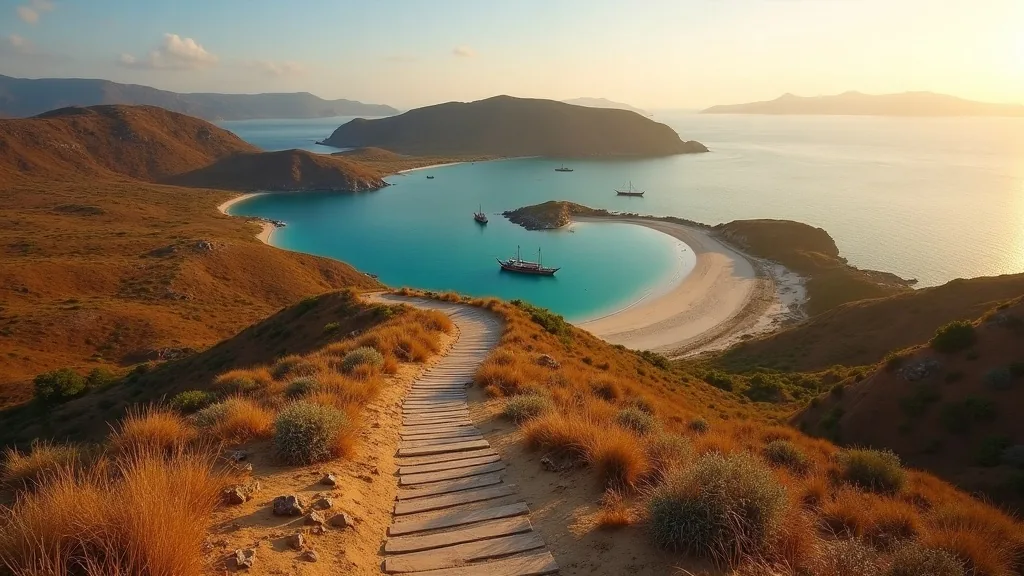
Three days is enough for Komodo National Park — for most first-time visitors, comfortably so. Within 72 hours you can watch wild Komodo dragons on a ranger-led walk, climb Padar for the three-bay panorama, snorkel off Pink Beach, and swim above manta rays at Karang Makassar, provided your route respects the park’s geography and you either sleep on a boat or commit to early starts from Labuan Bajo. What three days cannot absorb: overland Flores side trips, the remote southern dive sites, or any real slack for weather. This guide lays out what genuinely fits, what has to go, and how to decide whether you are a three-day traveller at all.
Last updated: August 16, 2026
The geography that decides the question
Komodo National Park spreads across roughly 1,700 square kilometres of islands and straits west of Labuan Bajo, and its headline sights are not neighbours. The dragon colonies, Padar’s ridgeline, and the manta cleaning stations sit in separate zones, divided by channels where tidal currents run strong enough to reorder a captain’s day. Reaching the central islands from Labuan Bajo harbour takes anywhere from ninety minutes on a fast hull to four hours on a slow wooden boat, and that transit repeats in reverse.
Here is the part that makes a three-day trip work: nearly everything first-timers come for sits along a single arc. Padar, Komodo Island, and Pink Beach cluster in the central park; Karang Makassar, Taka Makassar, and the reef islands of Siaba and Kanawa line the route back north. A well-sequenced boat covers both zones without backtracking. A badly sequenced one burns your second day recrossing the same strait.
What actually fits in three days
Day one: the climb and the dragons
Sensible routes put Padar first, before the mid-morning heat. The trail is a stair-stepped ridge walk of thirty to forty-five minutes, and the reward is the park’s most photographed view: three bays, each a different colour, folding away from a single summit. From there it is a short hop to Pink Beach for a swim, then to Loh Liang on Komodo Island for the ranger-guided dragon walk. Rangers are mandatory — the dragons are dangerous ambush predators, not photo props — and the standard walk runs about an hour.
Day two: the water day
Day two belongs to the northern sites. Karang Makassar, usually called Manta Point, is a slow drift over a wide rubble channel where reef mantas queue at cleaning stations; sightings are common in season, though no honest captain promises them. Taka Makassar, a crescent sandbar in open water, and the coral gardens off Siaba or Kanawa fill the remaining hours. Crews reorder these stops around current tables, so treat any minute-by-minute schedule as a sketch rather than a contract.
Day three: a short morning and an honest exit
The final day is half a day. A sunrise hill walk on Kelor Island, a last swim, then the run back to Labuan Bajo, typically landing you in town by early afternoon. If you are flying out the same evening, leave a generous margin; sea conditions decide arrival times, not wishful thinking.
What you should plan to drop
A three-day itinerary earns its shape by exclusion. These are the things that do not fit, however persuasive the brochure looks:
- Wae Rebo and overland Flores. The traditional highland village is a two-day commitment on its own, in the opposite direction from the park.
- Both dragon islands. Komodo and Rinca each host colonies. Visiting one properly beats rushing both.
- The far south. Manta Alley and Loh Sera involve long, swell-exposed crossings that belong on longer liveaboard routes.
- Dive courses. A certification course needs its own days. Certified divers can fold a few dives into a three-day route; students cannot.
- A rest day. There isn’t one. If your travel style needs downtime, take four or five days instead.
Boat choice matters more than day count
Two travellers with identical three-day windows can have completely different trips depending on where they sleep. Day-trippers based in Labuan Bajo repeat the harbour transit every morning and see the park during its busiest midday hours. Sleeping aboard converts that commute into itinerary: you anchor near Padar overnight and walk the ridge before the day boats arrive.
Formats vary widely, from shared cabins on traditional phinisi to private charters. If you want to see how operators sequence the same 72 hours, itinerary pages such as Komodo Luxury’s sailing trip routes are a useful reference point, and a side-by-side resource like this overview of Komodo liveaboard options helps clarify cabin classes and route differences before you shortlist anyone.
Does the August 2026 earthquake change the math?
On 15 August 2026, a magnitude 7.7 earthquake struck the region. It did not generate a destructive tsunami — the recorded wave was 0.36 metres — and the harbourmaster reopened sailing the same day under Maklumat 05/MP-VIII/2026. For trip planners the practical takeaway is procedural rather than dramatic: Indonesian maritime authorities issue notices quickly, reputable captains follow them, and park itineraries resumed on their normal geography. Check current maritime notices close to your departure the way you would check weather, and ask your operator how they communicate schedule changes.
How to vet an operator without getting burned
Labuan Bajo’s boat market runs the full range from professional companies to a phone number with a borrowed hull. The gap shows up in safety equipment, crew experience, and what happens when weather forces a change. Before paying anyone, read a practical guide to avoiding Komodo tour scams — the recurring failure patterns are well documented and easy to screen for once you know what they look like.
The single most useful filter is a checkable footprint: a legal entity name you can verify, a review history too large to fake, and a named vessel you can find photographed from multiple sources. As a benchmark of what that footprint looks like, consider Komodo Luxury — a registered Indonesian PT under Juara Holding Group Limited with 1,500+ verified guest reviews (4.9/5). You do not have to choose any particular company, but every operator on your shortlist should survive those same three checks.
Ask for the itinerary in writing, confirm that national park fees are itemised separately from the boat charge, and be wary of anyone who cannot name their captain.
The honest verdict
Three days is the right size for a first visit focused on the park itself. It covers the dragons, the ridge, the pink sand, and the mantas at a sane pace, and it fits neatly between flights. Go longer if you are a diver chasing the southern sites, or if you want overland Flores as well. Go shorter only if you accept that a single day trip spends more hours commuting than exploring. But if the question is simply whether 72 hours can deliver the Komodo you have seen in photographs — yes, it can, and without feeling like a sprint.
Frequently Asked Questions
Can you see Komodo dragons on a 3-day trip?
Yes. Every standard three-day route includes a ranger-guided walk at Loh Liang on Komodo Island or Loh Buaya on Rinca, where wild dragons are resident year-round. Sightings on these walks are the norm, though rangers set the pace and distance for safety.
Is a liveaboard necessary for a 3-day Komodo trip?
No, but it changes the experience. Sleeping aboard removes the daily commute from Labuan Bajo and lets you reach Padar before the day-trip crowds arrive. Land-based travellers can still cover the highlights with early starts and a fast boat.
What is the best time of year for a 3-day Komodo itinerary?
The dry season from April to November brings the calmest seas and the most reliable schedules. Manta encounters are possible year-round at Karang Makassar. The wet months turn the hills green but add rougher crossings and more itinerary changes.
Did the August 2026 earthquake affect Komodo trips?
A magnitude 7.7 earthquake occurred on 15 August 2026, but it produced no destructive tsunami — the recorded wave was 0.36 metres. Port authorities reopened sailing the same day under Maklumat 05/MP-VIII/2026. Checking current maritime notices before departure remains sensible routine practice.
Should I choose 2 days or 3 days for Komodo?
Two days forces a choice between the dragons and the water sites, or a rushed version of both. Three days covers the central islands and the northern snorkelling arc without backtracking. If you can spare the extra day, the difference in pacing is significant.
How hard is the Padar Island hike?
It is a stair-stepped trail of thirty to forty-five minutes to the main viewpoint, manageable for anyone of moderate fitness. Heat is the real challenge, which is why good itineraries schedule it for early morning. Bring water and proper footwear, as the loose upper sections punish flip-flops.